Skip to content
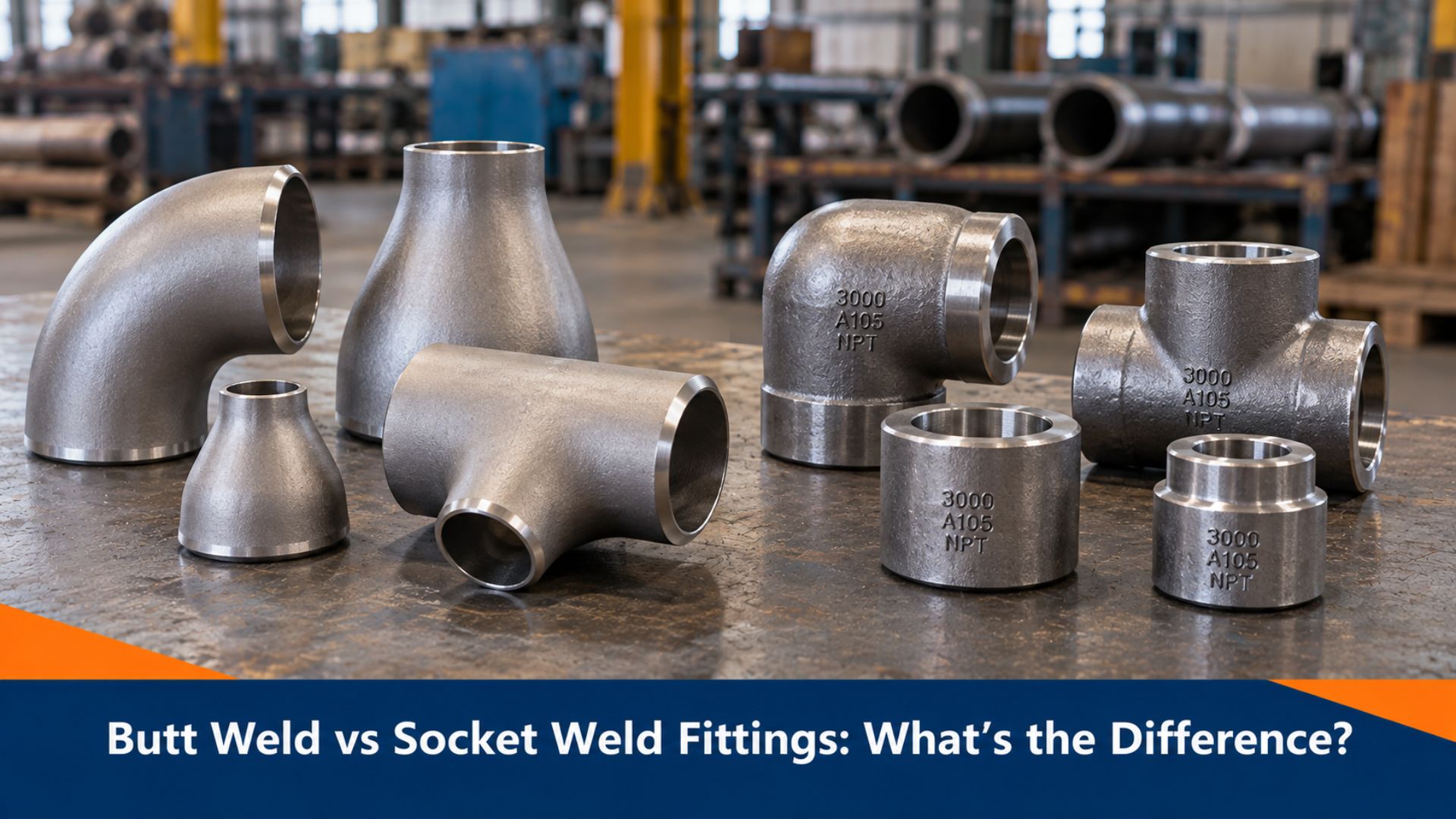
When selecting fittings for an industrial piping system, the connection method can affect installation, inspection, flow characteristics, maintenance, and long-term performance. Two widely used options are butt weld and socket weld fittings.
Although both create permanent welded connections, their joint geometries and fabrication methods differ. Butt weld vs. socket weld is therefore an important comparison when selecting fittings for a specific piping application. Butt weld fittings are joined end-to-end with the pipe, while socket weld fittings receive the pipe into a recessed socket before the joint is welded.
So, how do you determine which connection method is appropriate for a particular system? The right choice is not simply a matter of which fitting is stronger or easier to install. Pipe size, operating conditions, service fluid, corrosion considerations, inspection requirements, and the applicable piping specification must all be considered.
What Is a Butt Weld Fitting?
A butt weld fitting is designed to connect to the pipe end-to-end. The pipe and fitting are aligned, and the joint is welded around the circumference.
The ends are prepared for welding according to the applicable requirements. ASME B16.25 covers the preparation of butt-welding ends, including bevels and other end-preparation requirements.
Butt weld fittings commonly include elbows, tees, reducers, and caps. ASME B16.9 covers factory-made wrought butt-welding fittings in sizes from NPS 1/2 through NPS 48 and specifies requirements including dimensions, tolerances, ratings, testing, and marking.
Because the fitting connects directly to the pipe bore, the completed joint can provide a relatively smooth internal flow path. This makes butt weld fittings suitable for many process, transmission, and industrial piping applications where flow characteristics, structural integrity, and inspection are important.
What Is a Socket Weld Fitting?
A socket weld fitting has a recessed area, or socket, into which the pipe is inserted. The joint is then completed with a fillet weld around the outside of the connection.
Socket weld fittings are covered by ASME B16.11, which specifies requirements for ratings, dimensions, tolerances, marking, and materials for forged socket-welding and threaded fittings. Socket-weld fittings are designated by pressure classes including Class 3000, 6000, and 9000.
The socket arrangement simplifies alignment because the pipe fits inside the fitting. This makes the connection particularly useful for small-bore piping where compact dimensions and relatively straightforward fit-up are valuable.
However, the socket configuration creates an internal area at the bottom of the socket that needs to be considered during design, particularly for corrosive or cyclic service.
Butt Weld vs Socket Weld: Key Differences
| Comparison factor | Butt weld fittings | Socket weld fittings |
| Connection | Pipe and fitting joined end-to-end | Pipe inserted into a recessed socket |
| Weld type | Groove weld | Fillet weld |
| Common standard | ASME B16.9 | ASME B16.11 |
| Typical application | Medium and large-bore piping, process lines | Small-bore piping and compact connections |
| Pipe preparation | Requires appropriate end preparation | Generally requires less end preparation |
| Internal flow path | Generally smoother | Socket geometry creates an internal recess |
| Alignment | Requires accurate alignment | Socket provides positioning assistance |
| Inspection | Greater scope for volumetric examination of the weld | Inspection options differ because the weld is a fillet weld |
| Installation | More preparation and welding work | Relatively straightforward fit-up |
| Key consideration | Fabrication quality and weld integrity | Size, service conditions, corrosion and fatigue considerations |
The comparison shows why neither connection type should automatically be considered better. The appropriate choice depends on the requirements of the piping system.
Butt Weld vs Socket Weld: How Do the Joints Differ?
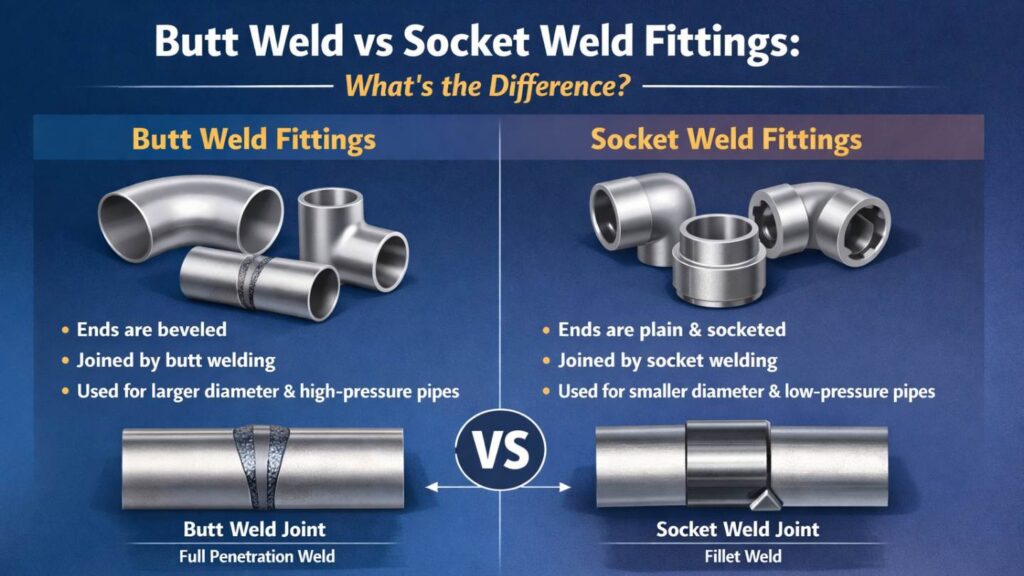
The most important difference is the geometry of the connection.
With a butt weld, the pipe and fitting meet at their ends. The weld joins the prepared ends and can be designed as a full-penetration groove weld where required by the applicable specification.
With a socket weld, the pipe enters the fitting and the weld is deposited around the outside of the pipe at the fitting face.
This difference affects how the joint is fabricated, inspected, and behaves in service. The socket arrangement is convenient for small-bore connections, while the butt-weld arrangement provides a continuous welded connection without the socket recess.
Which Is Better for Flow?
Butt weld fittings generally provide a smoother internal transition because the fitting and pipe are joined end-to-end. This can be advantageous where internal flow characteristics, reduced turbulence, or ease of cleaning are important.
Socket weld fittings have a socket configuration that can introduce an internal discontinuity at the end of the pipe. In services where deposits, stagnant areas, or internal cleanliness are concerns, this geometry needs to be considered during fitting selection.
The actual effect on flow depends on the fitting geometry, pipe size, system design, fluid properties, and operating conditions.
Which Is Easier to Install?
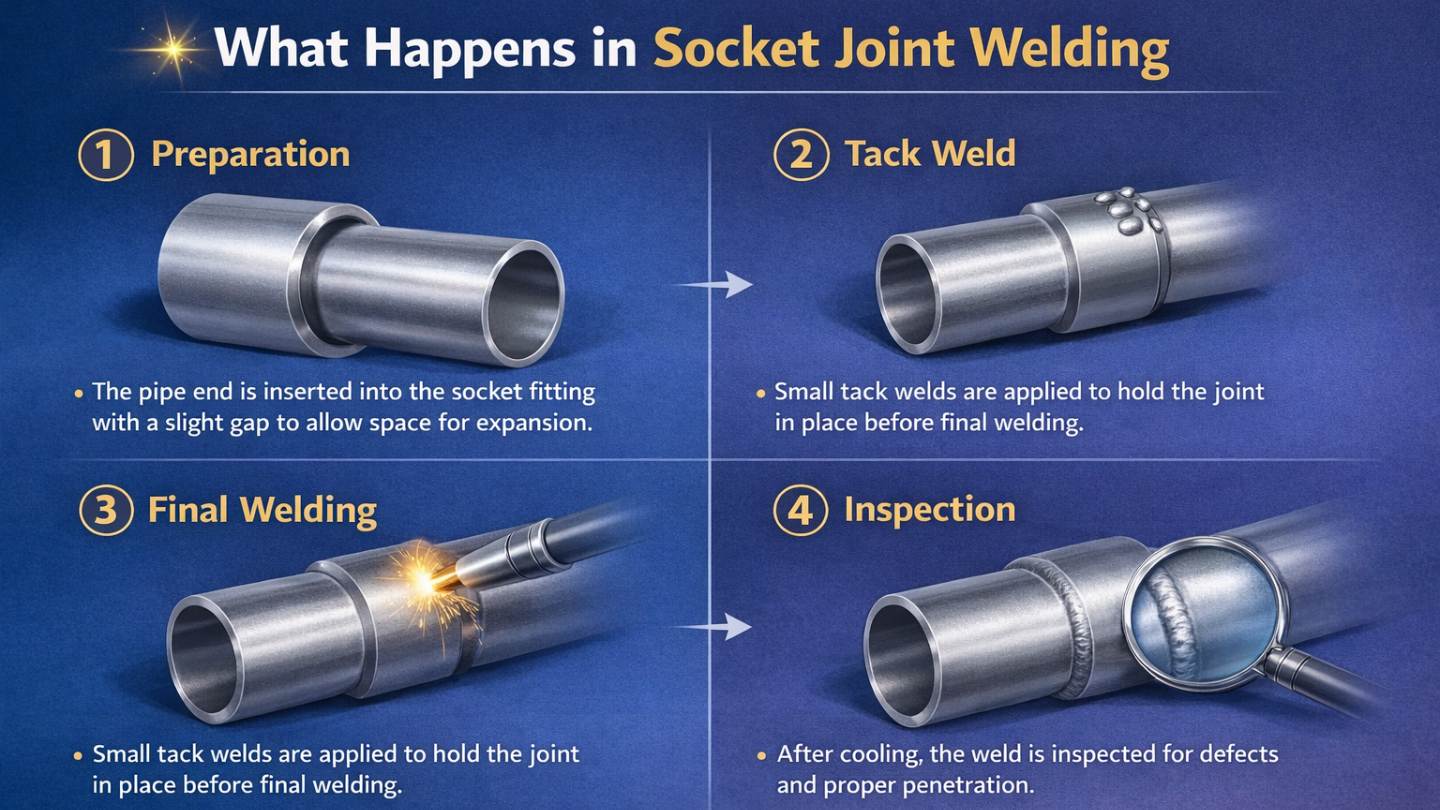
Socket weld fittings generally require less pipe-end preparation than butt weld fittings. The pipe is inserted into the fitting socket, aligned, and welded around the outside.
Butt weld fittings require accurate end preparation and alignment before welding. The fabrication process can therefore involve more preparation and welding effort.
However, installation speed should not be the only selection criterion. A fitting that is faster to install may not be the appropriate choice if the service requires a different joint configuration, inspection method, or corrosion-control strategy.
What About Corrosion and Fatigue?
Socket weld connections require particular attention in services where corrosion or cyclic loading may be significant.
The socket arrangement leaves an internal area between the pipe end and the bottom of the socket. If the service allows corrosive fluid to remain in this area, localised corrosion can become a design consideration.
Fatigue is another consideration because the geometry of a socket weld creates a different stress distribution from a butt-welded joint. For systems subject to significant cyclic loading, vibration, or thermal cycling, the applicable piping code and project specification should be reviewed before selecting the connection type.
This does not mean socket weld fittings are unsuitable for demanding services. They are widely used in high-pressure small-bore applications. The important point is that service conditions must be evaluated rather than selecting a fitting solely on pressure or size.
How Do Inspection Requirements Differ?
Inspection is another important distinction.
A butt-welded joint can be designed and inspected using applicable volumetric and surface examination methods, depending on the governing code and project requirements. ASME B16.25 addresses the preparation of butt-welding ends, while the applicable piping code determines the inspection requirements for the completed weld.
Socket welds are fillet-welded connections, so the inspection approach is different. Visual and appropriate surface examination methods may be specified, while the suitability and extent of any additional examination depend on the project requirements.
For critical piping systems, inspection requirements should therefore be considered during the design and fitting-selection stage rather than after fabrication.
When Should You Choose Butt Weld Fittings?
Butt weld fittings are generally considered when the piping system requires:
- A continuous welded connection
- A smoother internal flow path
- Larger pipe sizes
- Extensive weld examination
- Good suitability for process piping
- Reduced concern about socket-related internal recesses
- A connection compatible with the project’s welding and piping specifications
They are widely used in refineries, petrochemical facilities, power plants, process plants, pipelines, and other industrial piping systems.
When Should You Choose Socket Weld Fittings?
Socket weld fittings can be appropriate when the piping system involves:
- Small-bore connections
- Compact installation areas
- High-pressure small-bore services where socket welding is permitted
- Applications where socket fit-up provides practical installation advantages
- Piping specifications that permit socket-weld connections
Common applications can include instrumentation, utility lines, hydraulic systems, and other small-bore industrial services.
The final decision should always follow the applicable piping code, project specification, service conditions, and line class.
Which One Should You Choose?
There is no universal answer to whether butt weld or socket weld fittings are better.
A practical selection should consider:
- Pipe size and wall thickness
- Pressure and temperature
- Fluid characteristics
- Corrosion mechanism
- Cyclic loading and vibration
- Required inspection and testing
- Installation conditions
- Applicable piping code and project specification
- Lifecycle and maintenance requirements
For example, a small-bore utility line may be well suited to socket weld fittings, while a larger process line requiring a continuous welded connection may call for butt weld fittings.
The correct fitting is the one that satisfies the complete engineering and service requirements of the piping system.
Conclusion
Butt weld and socket weld fittings are both established solutions for industrial piping, but they are designed around different connection geometries and fabrication requirements. Butt weld fittings provide an end-to-end welded connection and are widely used across medium- and large-bore process piping. Socket weld fittings provide a compact connection for many small-bore applications where their use is permitted by the applicable specification.
At KAFCO Asia, we understand that fitting selection has to go beyond simply comparing product types. Material, dimensions, pressure class, pipe size, service conditions, applicable standards, and project requirements all influence the right specification.
We supply industrial piping products and fittings for applications across oil and gas, petrochemical, power, construction, and other industrial sectors. If you are looking for a butt-weld fittings manufacturer in India for your piping requirement, enquire with your specifications and project details.
Frequently Asked Questions
Why is there a gap between the pipe and the bottom of a socket weld fitting?
The pipe is not intended to be forced fully against the bottom of the socket during fit-up. The specified arrangement provides room for thermal expansion and helps avoid problems associated with the pipe being tightly restrained inside the fitting. The exact fit-up requirements should follow the applicable welding and piping specification.
Can socket weld and butt weld fittings be used on the same piping system?
Yes. A piping system can contain both types where permitted by its engineering design and specifications. Different sections may use different connection types based on pipe size, service, accessibility, and other design considerations.
Are socket weld fittings suitable for corrosive service?
They can be used in some corrosive services, but the socket geometry needs careful evaluation because the internal recess can create an area where corrosive fluid may accumulate. Material selection, service chemistry, corrosion allowance, and the applicable project specification should all be considered.
Which standard covers butt weld and socket weld fittings?
ASME B16.9 covers factory-made wrought buttwelding fittings, while ASME B16.11 covers forged socket-welding and threaded fittings. ASME B16.25 covers the preparation of buttwelding ends. The applicable piping code and project specification may impose additional requirements.