Skip to content
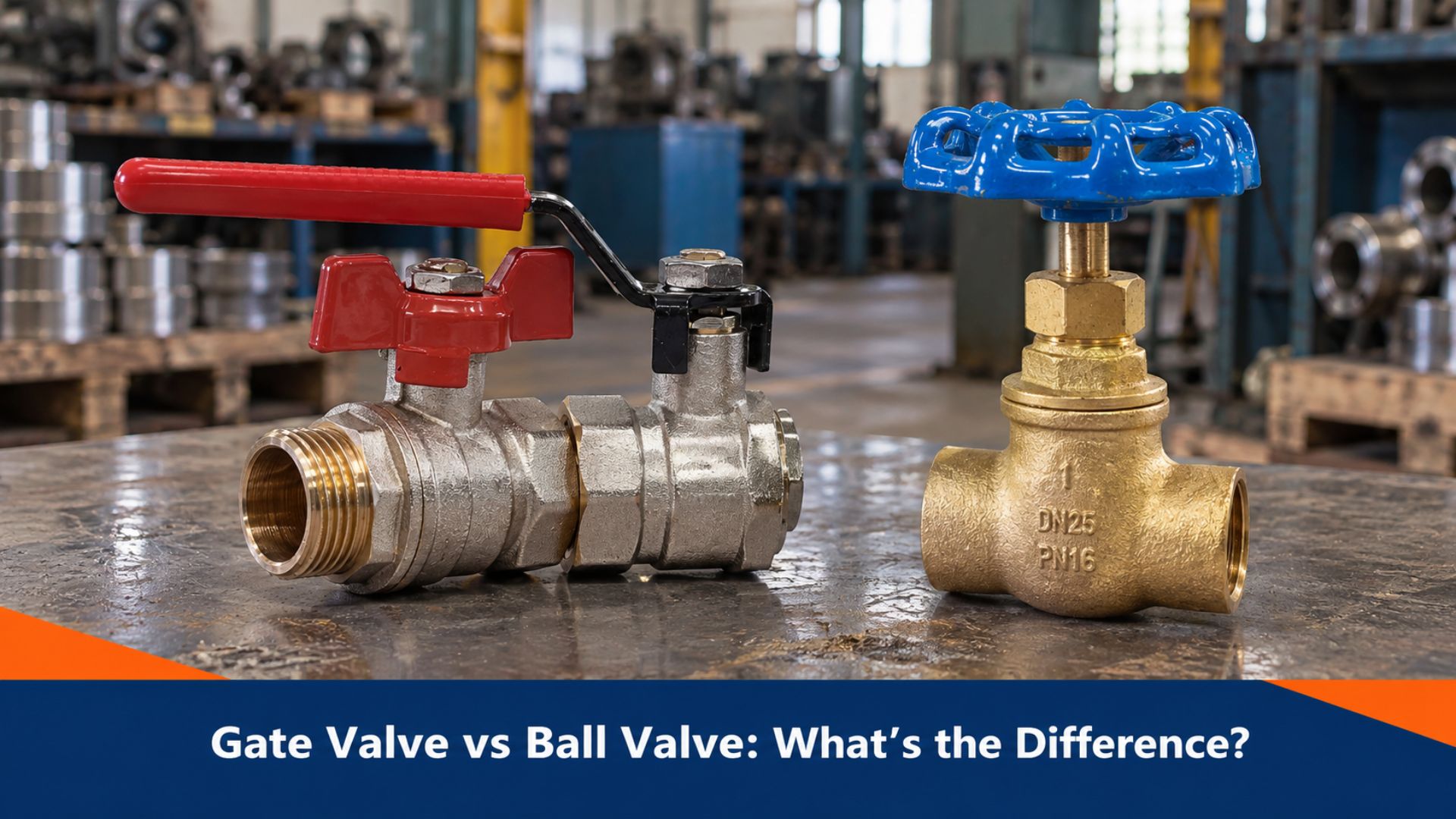
Gate valve and ball valve are two widely used options for isolating flow in industrial piping systems. Both can start or stop the flow of liquids and gases, but their designs, operating mechanisms, and performance characteristics are different. So, when comparing a gate valve vs ball valve, what should you actually look for? Understanding how each valve works and where it is typically used can help engineers and buyers make a more informed selection for their piping requirements.
A gate valve uses a gate that moves up and down to open or close the flow path. A ball valve uses a rotating ball with a central bore and operates with a quarter-turn.
Understanding these differences is important when selecting a valve for a particular piping system. Factors such as pipe size, pressure, temperature, flow requirements, operating frequency, and service conditions all influence the right choice.
What Is a Gate Valve?
A gate valve uses a wedge or gate-shaped closure element that moves perpendicular to the flow path. Turning the handwheel raises or lowers the gate inside the valve body.
When fully open, the gate moves out of the main flow passage, allowing fluid to pass with relatively low resistance. Gate valves are therefore commonly selected for applications where the valve remains fully open or fully closed for extended periods.
Gate valves are intended primarily for isolation rather than flow regulation. Keeping a gate valve partially open can expose the seating surfaces to high-velocity flow and may cause premature wear.
What Is a Ball Valve?
A ball valve uses a spherical closure element with a central bore to control fluid flow. The ball rotates inside the valve body, allowing the bore to align with the pipeline when the valve is open and blocking the flow path when it is closed.
A 90-degree turn moves the valve from fully open to fully closed, making it faster to operate than a multi-turn gate valve. Ball valves are also known for their reliable shut-off performance and are available in different designs, materials, and configurations for a wide range of industrial applications. For information on common operating issues and solutions, see our ball valve repair guide.
Gate Valve vs Ball Valve: Key Differences
| Feature | Gate Valve | Ball Valve |
| Operating method | Multi-turn | Quarter-turn |
| Closure element | Gate or wedge | Rotating ball |
| Opening and closing speed | Relatively slow | Fast |
| Full-open flow | Very low restriction | Very low restriction in full-bore designs |
| Shut-off | Effective isolation | Excellent shut-off capability |
| Frequent operation | Generally less suitable | Generally more suitable |
| Installation space | Usually requires more vertical clearance | Generally more compact |
| Typical application | Mainline and infrequent isolation | Quick and frequent isolation |
| Throttling | Not recommended | Generally not intended for continuous throttling |
The comparison shows that neither valve is universally better. The selection depends on how the valve will operate within the piping system.
How Do Gate Valves and Ball Valves Work Differently?

The primary difference is the movement of the closure element.
A gate valve uses linear movement. The gate travels upward to open the passage and downward to stop the flow. Because the mechanism requires multiple turns of the handwheel, operation is slower.
A ball valve uses rotary movement. The ball turns through approximately 90 degrees between the open and closed positions. This allows much faster isolation and makes ball valves useful where rapid operation is important.
This difference in operating mechanism also affects the valve’s installation, maintenance, actuation, and suitability for different services.
Gate Valve vs Ball Valve: Flow and Pressure Drop
When fully open, a properly selected gate valve provides a relatively unobstructed flow path. This makes it useful where maintaining flow capacity and minimizing pressure loss are important.
A full-bore ball valve can also provide a nearly straight flow passage when open. However, reduced-bore ball valves can introduce more flow restriction than full-bore designs.
The actual pressure drop depends on the valve design, bore size, flow rate, fluid properties, and operating conditions. Therefore, valve type alone should not be used to estimate system pressure loss.
Which Valve Is Better for Frequent Operation?
Ball valves generally have an advantage when a valve needs to be opened and closed frequently.
Their quarter-turn mechanism allows quick operation, while their compact design can also make them easier to automate with pneumatic or electric actuators.
Gate valves are better suited to applications where the valve remains in one position for long periods and is operated mainly for maintenance or system isolation.
For this reason, ball valves are often considered for applications requiring frequent cycling or rapid shut-off, while gate valves are commonly used for less frequent isolation.
Gate Valve vs Ball Valve for High Pressure and Temperature
Both valve types are available for demanding pressure and temperature conditions. The suitability of a particular valve depends on its design, materials, pressure class, seat construction, temperature rating, and the applicable standard.
It is therefore not accurate to say that a gate valve is always better for high pressure or that a ball valve is only suitable for low-pressure service.
For example, ball valves are available in designs intended for high-pressure industrial and pipeline applications. Gate valves are also widely used in high-pressure and high-temperature systems, particularly where full isolation and low flow resistance are required.
The valve should always be selected according to the actual operating conditions rather than pressure or temperature alone.
Gate Valve vs Ball Valve: Maintenance Aspect
Maintenance requirements depend on valve design, material, service conditions, operating frequency, and the quality of installation.
Gate valves can experience wear at the gate, seats, stem, and packing, particularly when operated frequently or used incorrectly for throttling. Debris in the pipeline can also interfere with proper seating.
Ball valves have a relatively simple operating mechanism and are generally well suited to frequent on-off operation. However, their seats and sealing components can be affected by temperature, chemical compatibility, abrasive particles, and repeated cycling.
Proper valve selection and maintenance are therefore more important than simply choosing one valve type based on its general reputation.
Where Are Gate Valves Commonly Used?
Gate valves are commonly used where reliable isolation and relatively low flow resistance are required.
Typical applications include:
- Water and wastewater systems
- Oil and gas pipelines
- Power generation facilities
- Petrochemical plants
- Industrial process piping
- Fire protection systems
- Large-diameter pipeline systems
They are particularly useful when the valve is expected to remain fully open or fully closed for most of its operating life.
Where Are Ball Valves Commonly Used?
Ball valves are widely used where fast operation and reliable shut-off are important.
Common applications include:
- Oil and gas systems
- Chemical processing
- Water and utility lines
- Compressed air systems
- Industrial equipment and skids
- Gas distribution systems
- Process isolation systems
Their quarter-turn operation also makes them suitable for automated systems where rapid actuation is required.
Gate Valve or Ball Valve: Which One Should You Choose?
The right choice depends on the requirements of the piping system.
Choose a gate valve when:
- The valve will be operated infrequently.
- Low flow resistance is important when fully open.
- The application involves larger pipeline sizes.
- The valve is primarily required for isolation.
- The system design and specifications call for a gate valve.
Choose a ball valve when:
- Fast opening and closing is required.
- Frequent operation is expected.
- Reliable shut-off is important.
- Compact installation is beneficial.
- Automation or quick actuation is required.
The final selection should also consider pressure, temperature, fluid characteristics, pipe size, valve materials, seat materials, actuation requirements, applicable standards, and project specifications.
Conclusion
Gate valves and ball valves both provide reliable flow isolation, but the right choice depends on the piping application. Gate valves are commonly used for infrequent isolation, while ball valves are preferred where quick operation and reliable shut-off are important.
At KAFCO Asia, we supply industrial valves selected for specific operating and project requirements. As a trusted valves manufacturer in India, we support applications across oil and gas, petrochemical, power, construction, and other industrial sectors. Contact us to discuss your valve requirements.
Frequently Asked Questions
Why does a ball valve close faster than a gate valve?
A ball valve uses a quarter-turn mechanism. Rotating the ball approximately 90 degrees moves it from the fully open to the fully closed position. A gate valve requires multiple turns because the gate travels vertically through the valve body.
Which valve is better for a large-diameter pipeline?
Gate valves are commonly used in large-diameter pipeline applications, particularly where the valve is required mainly for isolation and low flow resistance is important. However, the final selection depends on the project design and specifications.
Can ball valves be used for high-pressure applications?
Yes. Ball valves are available in designs suitable for high-pressure industrial and pipeline applications. The appropriate valve depends on the pressure class, body and seat materials, design, temperature, and applicable standards.
Can gate and ball valves be used in the same piping system?
Yes. A piping system can use both valve types where appropriate. Different sections may require different valves depending on pipe size, operating frequency, service conditions, pressure, and isolation requirements.