Skip to content

Ball valves are widely used in industrial piping systems for quick and reliable flow isolation. Their operation is based on a simple mechanism: a spherical ball rotates inside the valve body to either allow or stop the flow.
Although the principle is straightforward, several components work together to provide proper sealing, pressure containment, and smooth operation. Understanding the parts of a ball valve can help engineers, buyers, and maintenance teams make better decisions when selecting a ball valve for a particular application.
What Is a Ball Valve?
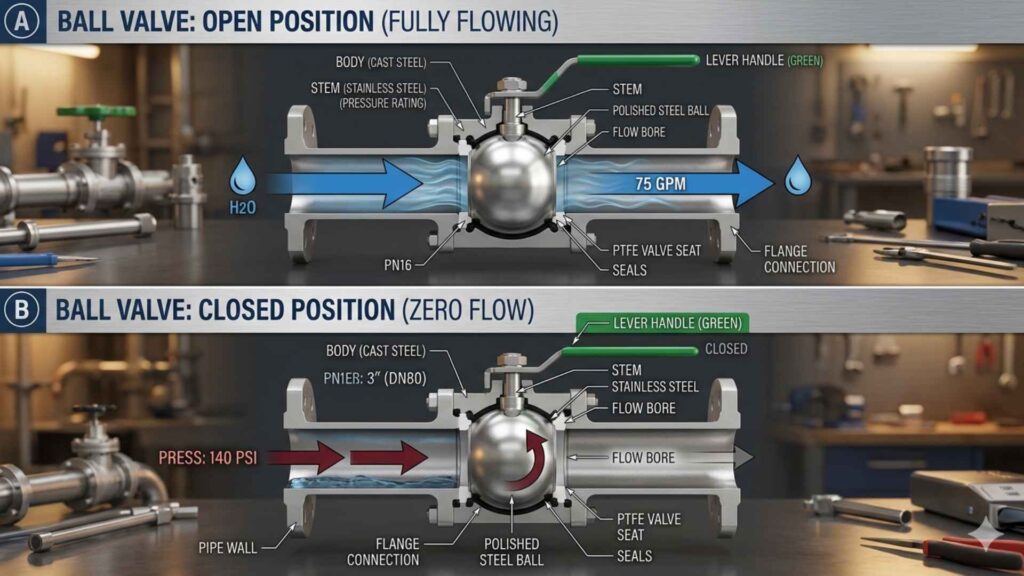
A ball valve is a quarter-turn valve that uses a spherical closure element with a bore through its centre. When the bore aligns with the pipeline, the valve is open and fluid can pass through. Rotating the ball approximately 90 degrees moves the bore away from the flow path and closes the valve.
Ball valves are primarily used for on-off isolation rather than continuous flow regulation. Their quarter-turn operation allows quick opening and closing, while the sealing arrangement provides reliable shut-off when the valve is correctly selected for the service.
What Are the Main Parts of a Ball Valve?
A typical ball valve consists of several components, each serving a specific purpose within the assembly.
Valve Body
The valve body is the main pressure-containing structure of the valve. It houses the ball, seats, stem, and other internal components while providing the connection to the piping system.
Ball valve bodies are available in different constructions, including one-piece, two-piece, and three-piece designs. The appropriate configuration depends on the valve design, application, and maintenance requirements.
Ball
The ball is the main closure element. It contains a central bore through which fluid passes when the valve is open.
When the ball rotates, the bore either aligns with the pipeline or moves across the flow path. Its surface finish and dimensional accuracy are important for achieving proper sealing with the valve seats.
Valve Seats
Valve seats form the sealing interface around the ball. When the valve is closed, the seats press against the ball to prevent fluid from passing through the valve.
Seat materials are selected according to factors such as pressure, temperature, fluid characteristics, and application requirements.
Stem
The stem connects the ball to the handle or actuator. It transfers rotational movement to the ball, allowing the valve to move between its open and closed positions.
The stem also passes through the valve body, so its sealing arrangement is important for preventing external leakage.
Seals and Packing
Seals and packing help prevent leakage from the valve, particularly around the stem and body connections.
The materials used for these components need to be compatible with the process fluid and the operating temperature and pressure of the application.
Bonnet
The bonnet, where applicable, forms part of the valve enclosure and supports the stem assembly. Its construction and connection to the body depend on the valve design.
Handle or Actuator
A manual handle allows an operator to rotate the stem directly. Larger valves or automated systems may use pneumatic, electric, or hydraulic actuators instead.
The actuator must provide sufficient torque to operate the valve reliably under the specified conditions.
End Connections
End connections attach the valve to the piping system. Depending on the design, they may include flanged, threaded, socket-weld, or butt-weld connections.
The appropriate connection depends on pipe size, pressure requirements, installation method, and project specifications.
How Does a Ball Valve Work?
The working principle of a ball valve is based on the rotation of its spherical closure element.
When the valve is fully open, the bore through the ball aligns with the pipeline, creating a direct passage for the fluid. When the handle or actuator rotates the ball approximately 90 degrees, the solid portion of the ball moves across the flow path and stops the fluid.
The seats maintain contact with the ball during operation and provide the sealing required when the valve is closed.
This quarter-turn mechanism is one of the main reasons ball valves are widely used where fast isolation is required.
What Are the Different Ball Valve Designs?
Ball valves are available in several configurations to suit different operating conditions and installation requirements.
Floating Ball Valve
In a floating ball valve, the ball is not fixed by a lower stem support. It can move slightly within the body, allowing line pressure to push the ball against the downstream seat and assist the sealing action.
Trunnion-Mounted Ball Valve
A trunnion-mounted ball valve uses additional mechanical support to hold the ball in position. This reduces the load on the seats and the torque required to operate the valve.
This configuration is commonly used for larger valves and demanding pressure applications.
Full-Port and Reduced-Port Ball Valves
Ball valves can also be classified according to the size of their internal flow passage.
A full-port ball valve has a bore that closely matches the connected pipe’s internal diameter, providing a relatively unrestricted flow path when fully open.
A reduced-port design has a smaller bore. It can offer advantages in valve size, weight, or cost, but it produces greater flow restriction than a comparable full-port valve.
Why Do Ball Valve Components Matter?
The performance of a ball valve depends on how its individual components work together.
The body must contain the operating pressure, the ball must rotate accurately, and the seats and seals must maintain the required sealing performance. The stem and operating mechanism must also transfer movement reliably.
For this reason, selecting a ball valve requires consideration of the complete assembly rather than one component alone. Material compatibility, pressure, temperature, process fluid, operating frequency, and applicable specifications all influence the appropriate design.
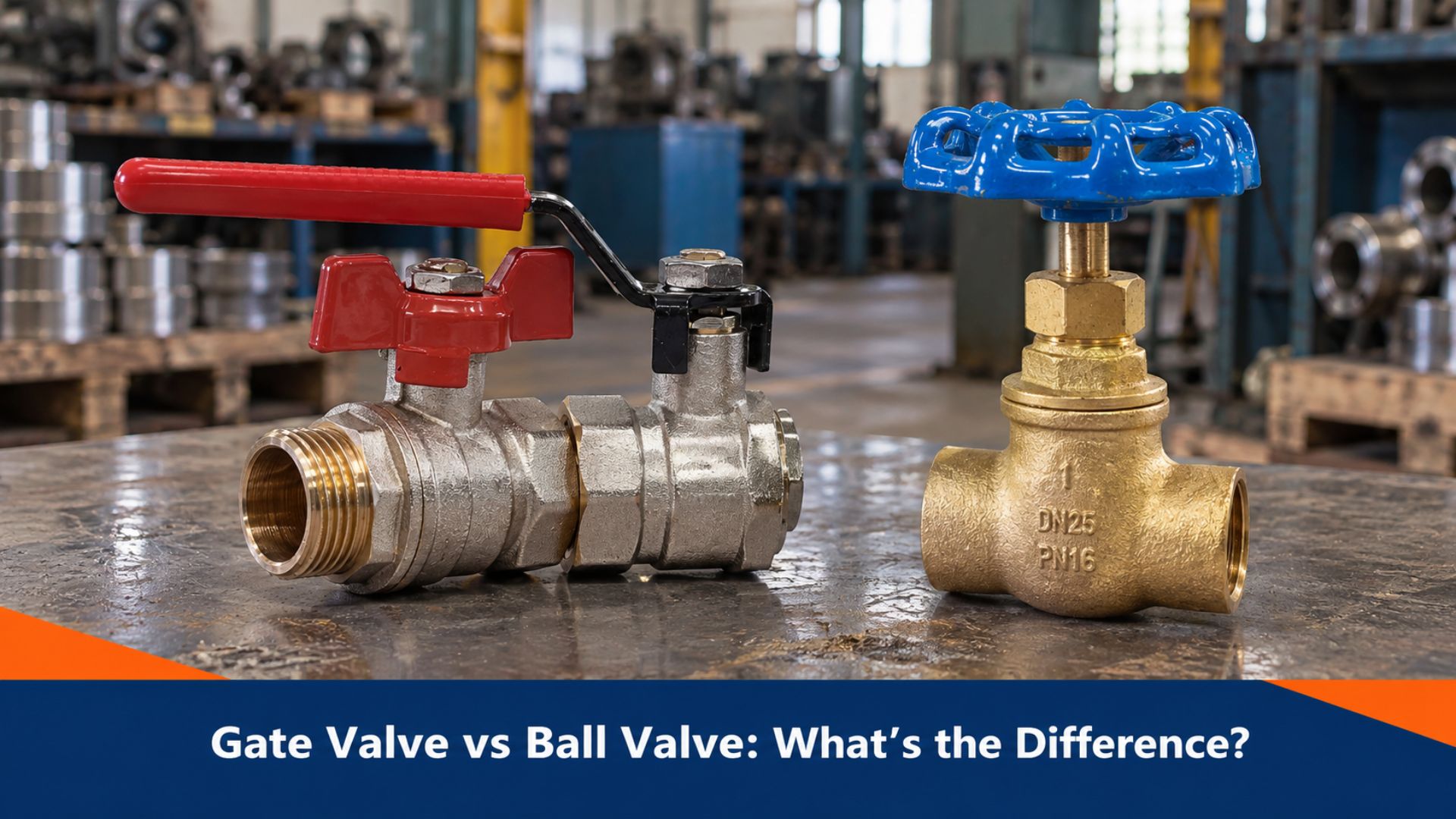
For readers comparing ball valves with another common isolation valve, our guide to gate valve vs ball valve explains how their operating mechanisms, flow characteristics, and applications differ.
Where Are Ball Valves Used?
Ball valves are used across a wide range of industrial applications where reliable isolation and quick operation are required.
Common applications include:
- Oil and gas facilities
- Petrochemical and chemical plants
- Power generation
- Water and wastewater systems
- Industrial process plants
- Gas distribution systems
- Manufacturing facilities
- Pipeline and utility systems
The required valve design can vary considerably between applications depending on pressure, temperature, fluid characteristics, materials, and project specifications.
What Should You Consider When Selecting a Ball Valve?
Choosing a ball valve involves more than selecting the correct nominal size. Important considerations include:
- Operating pressure and temperature
- Process fluid and its properties
- Valve body and trim materials
- Seat and sealing materials
- Full-port or reduced-port configuration
- Floating or trunnion-mounted construction
- End connection type
- Manual or automated operation
- Applicable standards and project specifications
A valve should be selected according to the complete operating environment rather than relying on a general-purpose specification.
Conclusion
A ball valve has a simple operating principle, but each component plays an important role in achieving reliable isolation and sealing. The body, ball, seats, stem, seals, and operating mechanism must work together to deliver dependable performance in the intended application.
At KAFCO Asia, we understand that reliable valve performance starts with the right design, materials, and application-specific selection. As a trusted valves manufacturer in India, we supply industrial valves and piping solutions for oil and gas, petrochemical, power, construction, and other industrial applications. Contact us with your requirements to discuss a suitable valve solution for your project.
Frequently Asked Questions
What is the difference between a floating and trunnion-mounted ball valve?
A floating ball valve allows the ball to move slightly and uses line pressure to assist sealing against the seat. A trunnion-mounted design mechanically supports the ball, reducing seat loading and operating torque.
Why does a ball valve use a quarter-turn mechanism?
The spherical ball only needs to rotate approximately 90 degrees to move its bore from alignment with the pipeline to a closed position. This provides quick operation compared with multi-turn valve designs.
What materials are used for ball valve components?
Component materials vary according to the application. Bodies, balls, and stems may be manufactured from carbon steel, stainless steel, alloy materials, or other suitable materials, while seats and seals are selected according to pressure, temperature, and fluid compatibility.
What is the difference between a full-port and reduced-port ball valve?
A full-port ball valve has a bore that closely matches the connected pipe’s internal diameter, while a reduced-port valve has a smaller flow passage. The latter can provide size or cost advantages but introduces more flow restriction.